Thursday, 6 November 2014

Guadalupe - Again!

It’s been quite a long time since I last blogged. I guess I got “blogged” down by things here! Sorry...
Anyway, I’ll try and update the blog with a few things that have happened in the last while.


The approach to the Basilica by way of a mall.


Meanwhile here’s a few more photos of the Basilica de Guadalupe – we, Marist Fathers, have had a couple of visits to celebrate Mass. Both times, it was one of the scheduled Masses. The idea was on both occasions to celebrate together. Afterwards we had a meal together in one of the nearby communities. Great occasions!
The modern Basilica


Detail of the doors of the Basilica


Chapel of the Blessed Sacrament

In the Sacristry (entry is carefully controlled) 
with Mexican Marist Seminarian, Jaime.

During Mass 
(photography in the sanctuary is strictly prohibited!)


A Selfie (with Our Lady of Guadalupe!)

The image that miraculously appeared on Juan Diego's clock - seen from the moving belt underneath the sanctuary


The hill of Tepeyac - site of Mary's original apparition to Juan Diego Cuauhtlatoatzin in 1531

The old basilica alongside the new basilica. Yes, the old basilica is leaning. The continued pumping of subterranean water has dried the ground on which it was built and caused it to lean. It has been stabilised! In the distance is the clock tower.

Pope St Juan Pablo II - a statue made with donations of keys from ordinary Mexicans. John Paul II visited Guadalupe four times.

The "veladoras" - a place outside the basilica where people can light their devotional candles - there are thousands!

With Fr. Juan Carlos, Mexican Marist Formador (in front of the old basilica)

Con Marco - future marist? In front of the new basilica.
The inscription reads "Am I not here, who am your mother?" Words of Mary to Juan Diego.

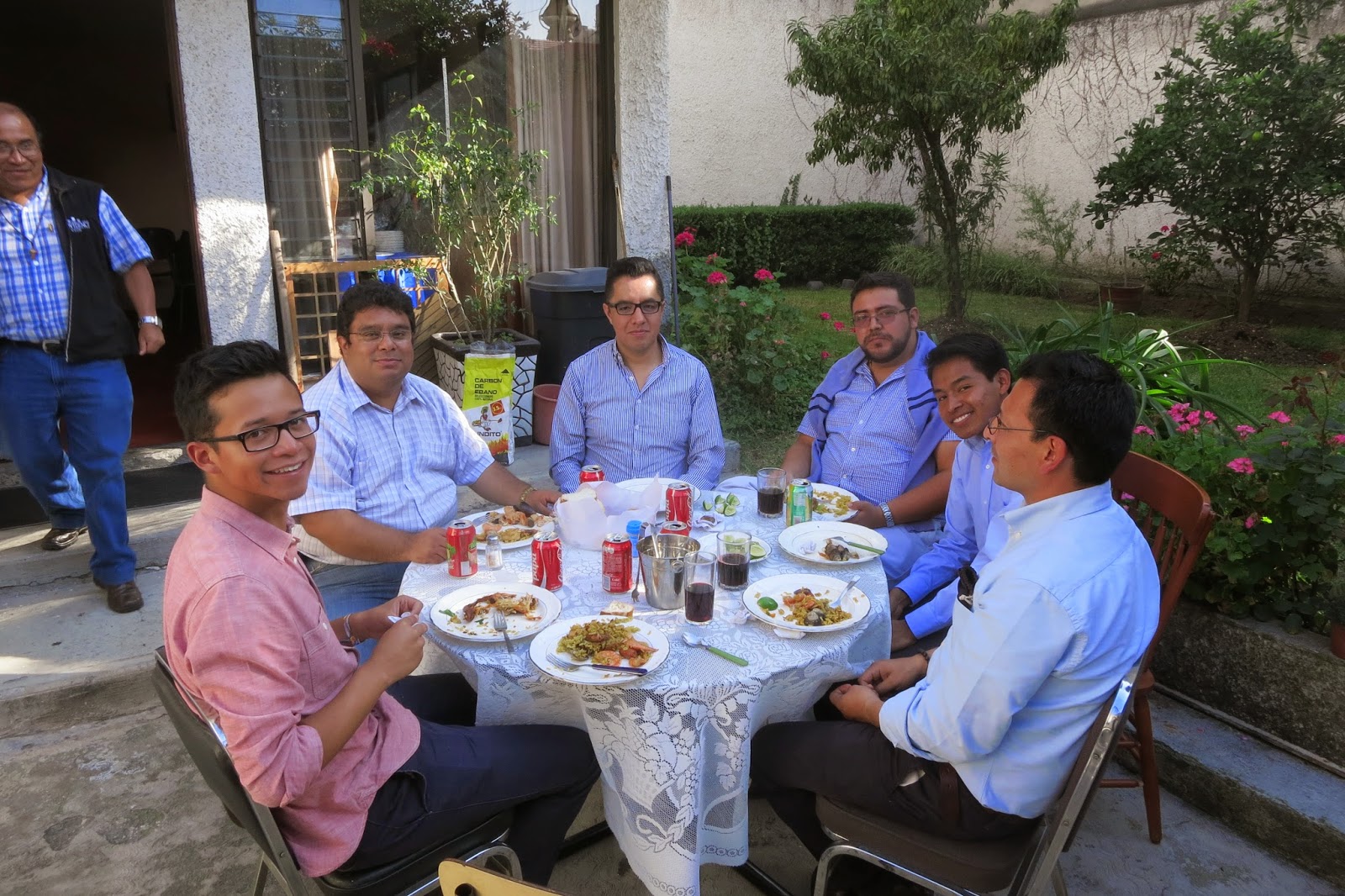
The after match function with Marist Fathers, seminarians and candidates - we had paella!

Oye y ten entendido, hijo mío el más pequeño, que es nada lo que te asusta y aflige. No se turbe tu corazón, no temas esa ni ninguna otra enfermedad o angustia. ¿Acaso no estoy aquí yo, que soy tu madre? ¿No estás bajo mi sombra? ¿No soy tu salud? ¿No estás por ventura en mi regazo?… 
Santa María de Guadalupe a San Juan Diego, 12 de Diciembre de 1531 

Listen and understand, my smallest son, this is nothing that scares or hurts you. Let your heart not be unsettled, don't be frightened of this, or of any other illness or worry. Am I not here, who am your mother? Are you not under my protection (in my shadow)? Am I not your wellbeing? Are you not for fortune under my gaze?..."
Saint Mary of Guadalupe to St John Diego, 12 de Diciembre de 1531.

Wednesday, 23 October 2013

Santa's Little Mexican Helpers

Contrary to popular belief, Santa’s House isn’t at the North Pole. That’s just silly – it’s too cold there. Actually his house is in the small Mexican town of Tlalpujahua! Tlalpujahua is just across the Mexico State – Michoacán state border, about a half hour drive from La Jordana, the ex Marist formation house and now retreat house.
The House of Santa Claus

It is one of Mexico’s “magic towns”, preserving colonial buildings around the plaza. Tlalpujahua predates the Spanish conquest. The name in Nahuatl means “spongy earth” – a reference to the soft soil it is built on.

La Plaza
Gold and silver mines were exploited by the Spaniards from 1551. Two churches were built – one for the Spaniards and one for the Indians!
The mines failed sometime in the 18th century and were reopened by English investors a century later. They didn’t last long.
The principal church, the Sanctuary of Our Lady of Mt Carmel was mostly built in the 17th century. A Franciscan convent of the same vintage is nearby.
The Interior of Our Lady of Mt Carmel - that's her above the altar, painted on an adobe wall. 

Oddly enough, the town is now known for the various factories that make Christmas decorations. None of your plastic Chinese decorations. These are glass and hand decorated – and incredibly cheap! At one stage this small town was the worlds biggest producer of glass Christmas baubles! And Santa’s house is in the middle of town!

The church seems to have suffered somewhat from the same desire to decorate. The baroque interior can only be described as “Mexican wedding cake” style. Oddly enough it doesn’t really seem to be over the top in the context!
A close up of the Painting of Our Lady of Mt Carmel. She was removed from an older church which was destroyed in a fire.

The flower and vegetable decoration on the ceiling.


Across the valley is the smaller township of Tlalpujahuilla. It’s a pretty ordinary town except for the sanctuary of the Virgin of San Juan. It’s a huge church – about the size of Wellington’s Cathedral of the Sacred Heart for such a small town. And that’s due to the devotion to the miraculous statue of Our Lady of San Juan. The church is massive – built in stone.
The front of Our Lady of San Juan, Tlalpujahuilla

From the side. The square building at front is where devotional candles are burnt.

The parish is obviously geared to the annual pilgrimage for the feast day. The toilets are industrial size and accessed by a pay turn style. I did wonder just how much money the parish made out of the dunnies in contrast to donations from the faithful!

The miraculous statue.

Behind the main altar, where the Statue of Our Lady is there is a room – and you can climb a staircase where there’s a cloth stretched across the top. It forces you to duck under – and it was only after doing this I noticed the signs that said something like: “Be covered by Our Lady’s Mantel” with an arrow pointing up the steps. I guess not something to be sneezed at. So I went around again!
Under the protection of Our Lady's Mantle

Still, it shows the strength of Mexican’s devotion to Mary. There are several other pilgrimage sites within an hour’s drive of Tlalpujahuilla.
One way to get the turkey home!

Friday, 28 June 2013

Tlaxcala: Cradle of the Faith in Mexico


On the pulpit of the Cathedral of Tlaxcala is a very old inscription that reads: “Aqui tubo principio el Sto Evangelio en este Nuevo Mundo” - “Here had its beginning the Gospel in this New World”.
The Pulpit

The Spanish Conquistadores advanced on Tenochtítlan from the Caribbean coast via Tlaxcala. Cortez’s troops defeated several subject nations of the Mexica people (roughly what we call the Aztecs). These defeated nations, like the Tlaxcaltecas, joined the Spanish. Cortez couldn’t have defeated Moctezuma without their help. The Conquistadores were accompanied by their chaplains: priests and friars. Some of these priests were looking to make their fortune; others were interested in converting the Indians. The sword and the cross conquered together…
The interior of the Cathedral

Chapel of San Francisco

Having been almost slaves of the Mexica Empire, most were quite happy to go to war against their old rulers. So much so that the tlaxcaltecas, after participating in the defeat of the Mexicas on the 12th of August 1521, returned to Tlaxcala. After several years when they converted, the Assumption of Mary was adopted as their patronal feast (The feast falls on the 15th of August, three days after “their victory over Tenochtítlan-Mexica alongside their allies, the Spaniards”). The Cathedral of Tlaxcala is dedicated to the Assumption.
The Main Altar

Interestingly Tlaxcala was considered a republic, vassal directly of the Spanish Crown, whereas the other provinces were part of the viceroyalty of “New Spain”, which in its turn was a vassal state of Spain.
When Franciscan friars arrived in 1524 they began the conversion of the Indians. They constructed an “open chapel” to facilitate this. Apparently the Indians were uncomfortable in an enclosed church. This building underwent several rebuilds in the early 17th century, but still exists. Baptisms were carried out here.
The Open Chapel

Inside the Cathedral exists an old baptismal font hewn from rock. An inscription claims that the first baptisms of four Indian “princes” took place in the font in 1520. One of their godfathers was Hernán Cortéz, the captain of the Conquistadores.
Baptismal Font - from 1520

In 1541 Mary appeared on a hill, Ocotlán, overlooking Tlaxcala. There seems to have been some confusion between the Assumption of Mary and the Immaculate Conception – perhaps because the Indians had heard of the Assumption and adopted this devotion, but seen a painting of the Immaculate Conception and copied that. The statue in the shrine at Ocotlán is of the Immaculate Conception! An easy mistake to make!
The Interior of the Shrine of Ocotlán

The Assumption/Immaculate Conception...

Below the Cathedral is the bullring. It is the oldest in Mexico. There was a group of kids, practicing their manoeuvres. A lad with a rake was the bull; the toreador used a cape and a small sword. Father Alejandro showed us some moves – learnt while a lad himself on the family bull ranch.

The bullring from the Cathedral
Peter has a go with the cape.

The tower is the bell-tower of the Cathedral - and a Scotsman's stand (apologies to Willy!)

A raging bull!

The Tunnel


 Alejandro shows how it's done!


 A video of the kids in the bullring