Friday, 21 June 2013

Base Camp for the Conquest: Tlaxcala


Some time ago Alejandro, a Mexican Marist working in Rome, was home on holiday. He invited us to visit his family’s ranch. On the way there we stopped off in Tlaxcala, a small city not too far from Mexico City.
On the Plaza - Tlaxcala

What I want to show you are the murals that decorate the Municipal building. Murals are central to modern Mexican Art – the most famous being the murals of Diego Rivera, a socialist whose murals were a social commentary on the Mexico of the time. The murals in Tlaxcala were painted by Desiderio Hernandez Xochitiotzin. 
An overview of the stairway

A depiction of  pre-Conquest religious rites

In contrast to Rivera, Hernandez was a staunch Catholic – one of his sons was ordained a priest and taught Alejandro in the Seminary.
Pre-conquest Aztec foods - including nopales (cactus leaves) and tunas (cactus fruit) left bottom.

Quetzalcoatl - the white, plumed diety. Some historians maintain that Moctezuma thought Quetzalcoatl had arrived in the person of Cortéz


The Conquest of Mexica by Cortéz. The woman standing behind is horse is Malinche - Cortéz's common law wife.

Building began on the Municipality (Palacio de Gobierno - Palace of Government) in 1545. The murals are much more recent! They recount the history of Tlaxcala, the base from which the Spanish began the conquest of Tenochtitlan (the Aztec empire). The murals also recount more modern Mexican history.
The battle for Tenochtitlan - 1521

 The bishop of Tlaxcala, Fray Julian Garces petitioned Pope Paul III for protection for the Indigenous Peoples. The Bull "Sublimis Deus" 1537, defended their rights to freedom, property and respect. 


1810. The parish priest of Dolores Miguel Hidalgo y Costilla  begins the first Mexican Revolution against the Spanish with the "Cry of Dolores". He is later shot by the Spanish.

   
Tlaxcala also has the dowdiest Cathedral I've ever seen. It's dowdy because it's the original parish church. Some of the conquistadores were god-parents at early baptisms.

Monday, 28 January 2013

Pilgrimage to Cristo Rey

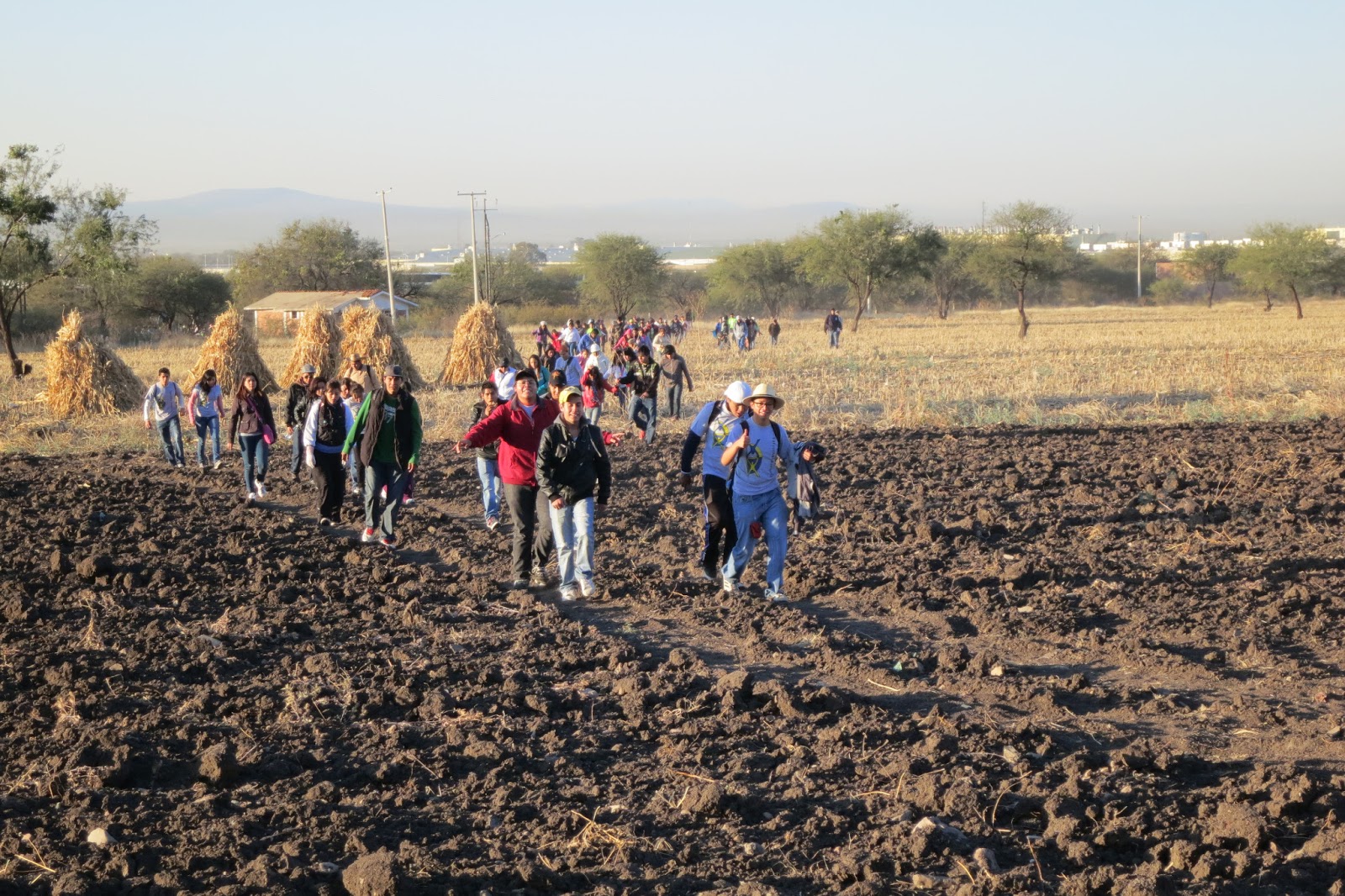
The Pilgrimage Group from the University Parish

We left the warmth of the bus and set off in the cold clear morning. Our route was through dry thorn covered fields toward the mountain in the distance. We could just make out a figure erected on the hilltop. I have to confess I had my doubts as to whether I could make it. It was an awfully long way a way! And my trekking companions were all about 35 years younger than me!
That's the Mountain of Cubilete in the distance...
 In 1926 the statue of Christ the King on the mountain of Cubilete in the State of Guanajuato was bombed on the orders of the Mexican president Plutarco Elías Calles. This was during the Cristeros rebellion caused by the persecution of the Church by the Mexican State. It was replaced in 1940 by the world’s largest bronze statue of Christ.
Our pilgrimage group - sticking together as always!

Now, each year tens of thousands of young people make the pilgrimage to where Cristo Rey towers over the plains. We left Toluca at 12.20am on Saturday. We were a little late so the bus couldn’t get to starting point in the village of Cubilete. This added some 4 or 5 kilometres to our trek. The way was lined with buses from all over Mexico. The fortunate early arrivals were parked high up the mountain.


A bit closer. We're just leaving the normal starting point - 13 kms uphill to go.

The cobble-stone track was a river of young people flowing toward the statue. Most were sporting colourful t-shirts announcing where they were from. Many were singing, thumping drums or strumming guitars. 
Unbelievably happy still! And wearing our t-shirt

The day warmed, partly due to the sun coming up but mostly due to the exertion of climbing the 2579 metres to the top. And I was the second of our group to the top. Living at 2750 metres above sea level helps make hill climbs easier! After a brief visit to the chapel underneath the statue we headed for Mass.
Me and my $5.00 hat! Long sleeves a must - the sun burns at that altitude.

On a plateau a hundred metres below the peak the thirty thousand or so celebrated Mass with Archbishop Christophe Pierre, who began his career as a Church diplomat as secretary to the nuncio in Wellington in 1977. I got to speak briefly with him after Mass and he told me he had very fond memories of his time in NZ and his visits to Mount St Mary’s, Greenmeadows.
Part of the 30,000 odd crowd. Mons Cristophe Pierre is the main celebrant
After Mass most of the youth began streaming up to Cristo Rey. Others began the descent. The system is that the buses begin the climb up the track and pick up their passengers as they go – as our bus was so far away we had to wait for more than three hours as a stream of buses filed past us. Still the atmosphere was still very festive. The kids began to swap t-shirts and some of ours found a rather chubby kid who was willing to swap with me! I did quite well out of the deal.
The buses parked on the track up the mountain - the track we climbed.
 Once we got on our bus we headed to San Miguel de Allende – a very picturesque town in the same state. We arrived late – I went to bed. The young ones went out on the town. Surprisingly most of them were awake early. After some sightseeing, souvenir buying we boarded the bus back to Toluca and were home by 7.30pm. A great weekend! 
Happy Birds - Christ the King Season, Cubilete 2013

Young Mexico, Renew your Faith - the chubby kid's t-shirt!

San Miguel at night - midnight to be exact!

By morning

Breakfast! (the lad on the right is having chiliquiles - corn chips smothered in hot green sauce and cheese!)

Parish church of St Micheal the Arcangel (pink stone)

Trying not to be too tall. I bought a $10 hat!

Monday, 26 November 2012

Mighty Monarchs!


Last week México celebrated the anniversary of the 1810 revolution. The date fell on Tuesday.  Most businesses took Monday instead – except for Government departments and schools that took Tuesday  - and just didn’t bother about turning up for work Monday!

We took Monday off and headed out into the Sierra Madre mountains in the hinterland of Mexico State. The Monarch Butterflies had begun arriving at the various sanctuaries in Mexico State and neighbouring Michoacán State. 
Our guide, Ricardo, points out the spots on the male Monarch

Our journey flanked the volcano, Xinantécatl that presides over Toluca. After a little more than an hour’s drive through lush pine forests we arrived at Piedra Herrada.
Local villagers run this eco-tourism centre, situated in a valley at about 2500 metres above sea level. Groups are limited and have to be guided. We already noticed a few monarchs flying around. We engaged a guide and set off.
As we climbed along a wide path winding through the forest we began to see more and more butterflies. They were mostly sitting in sunny clearing on damp earth or flowers. As the sun warms them, they fly down the mountain in search of water and nectar.

Our trek took sometime. We were stopping at every gathering of butterflies! Finally we arrived at where the Monarchs were “roosting” – on Cyprus trees at about 3200 metres (And, yes, the last few hundred metres were a bit of a slog!)

These Monarchs had flown from Canada and the United States – a journey of up to 5000km! They winter over in Mexico in twelve mountain sites. They don’t reproduce in Mexico. In spring (March here) they begin the journey back north. These butterflies wont be back. It will be a year and the fourth generation that returns – to a place they have never seen!

We visited early in the season – they had just opened the sanctuary. The butterflies were still arriving. The experience of seeing thousands of Monarchs in one place – and to hear their collective wing beats as they swarm is truly extraordinary. 

After the visit we headed off for lunch at Valle de Bravo – a small colonial town on the shores of a man-made lake. Soon after leaving the sanctuary, we began to encounter butterflies drifting across the highway. The passing lanes on the road were closed. The federal police were in attendance, all to make sure no one drove faster than 15km per hour and so avoid killing the Monarchs. This made me laugh. Mexican cops are not so good at doing this for humans!
That's a horse in the overtaking lane!
Valle de Bravo

There’s a new film coming out soon about these amazing creatures. You can watch the trailer at http://youtu.be/FvFEoYFZKqQ
My own humble film (done on a digital camera) is here: http://youtu.be/nnHWOk2lFL0

Thursday, 25 October 2012

El Día de los Muertos

People are getting excited! The First and Second of November are getting closer. At a meeting the other day the leaders of the four youth groups that operate here in the University Parish completely lost me. We were planning for this weekend’s extra activity – our celebration of All Saints’ and All Souls’ days. We’re celebrating it early All Souls’ day is known here as “El Día de los Muertos” - the Day of the Dead.
It’s all a bit confusing. To start with All Saints’ Day seems to have disappeared! Then there are the various celebrations around El Día de los Muertos. It seems we’ll offer Mass for the souls of the faithful departed known to the people who come here. There’ll be a box on the altar with their names in it.

Afterwards there’ll be a festival of “Calaveras” – Skulls. These are skulls made of sugar or chocolate and richly decorated. They’re exchanged and eaten. I’ve bought mine in readiness to exchange. It’s sort of like chocolate Easter Eggs and Secret Santa rolled into one!
Sometimes mocking poems – also called Calaveras - are read out. They usually mock authorities and the rich and famous – reminding them their earthly wealth and power wont last beyond the grave.
A highly decorated sugar skull

Las Calaveras originally were used as offerings to the souls of the dead on All Souls’ Day. Each household set up an altar. On the altar were placed food and sweets, especially the favourite ones of the deceased. These remain untouched during the day while the souls have an opportunity to come and enjoy the foods and sweets they enjoyed while they were alive.
A chocolate Calavera

Later the living are able to enjoy what the dead leave behind. One of the seminarians told me in all seriousness that food left on the altar is not as tasty as the same food left somewhere else – the implication being that the souls do take something with them – the taste! He quickly realised I had a somewhat sceptical look on my face and pointed out that it may be because the food and sweets are at room temperature all day and that might account for a lack of taste!
An Alfeñique Chook
The custom of altars and offerings on November 2nd is a mix of pre-Columbian indigenous traditions and Christian practice. The Aztecs (and other cultures) celebrated the ancestors by offering sacrifices – of fruit, maize, grains, animals – and humans. This practice was “baptised” by the missionaries and joined to the All Souls’ Day commemoration.
As part of our celebrations each of the youth groups is going to make “offerings” according to the tradition of different local indigenous tribes. I’m not entirely sure what these might be – and whether they’ll be offered during Mass or at some other time. Remember I got lost during the discussion with the youth leaders!
Alfeñique Deer
Skull and Bone sweets
I went to the Feria de Alfeñique in the centre of town today to buy my Calavera for the exchange. This is an annual event here in Toluca. There are about a hundred stalls set up selling all sorts of macabre sweets and handcrafts related to the Day of the Dead. I bought several Calaveras and chocolates in the form of bones. Alfeñique comes from Arabic and is a type of spun sugar used to make sweets. Most of the sweets in the stalls aren’t alfeñique – there were even some made from kumara! I’ll have to go back again!

Wednesday, 17 October 2012

Kai - in Mexico!


Food in México is a little different from NZ. Well, a whole lot different. Mexicans are very proud of their culinary traditions – as well they might be. Some of the things seem a little strange – like pork cracking. Except the whole dish is pork crackling (no meat) covered in green chile sauce... Probably not the healthiest meal…
Chilli is a constant – both cooked into the dishes and served as a salsa. The salsa, usually in a small dish on the table so you can add the amount you wish, is made of fresh chillies. There are a confusing number of varieties – with varying taste and hotness. This leads to the occasional mistake – one accompanied by tears and an immediate burning sensation – and a burning sensation a lot later too. The hottest chillies burn twice as the saying goes…
Pozole - maize (Elote), Jitomate (tomato), chilli, pork etc..
 Chilli makes even ‘blah’ food interesting. Yesterday we had soya – I guess a sort of tofu? What made it tasty was the red chilli sauce. And the day before it was ox tongue. Again made delicious by the green chilli sauce.  Neither was too spicy either.
We had an interesting experience while visiting an indigenous town. Every year a group from the University Parish does a mission in a village a couple of hours from Toluca. The Indians are Mazahuas. The men are known as traveling salesmen and range as far as the United States selling almost anything. The women stay at home and raise the kids. 
A great line-up! A shared meal Mazahua style.

After the mission group had done their catechising, we all shared a meal. The pots and plates of food were lined up outside the church, I blessed the meal and then visitors hoed in. The mission kids didn’t hold back either. It was traditional Mexican food with none of the processed stuff you get in the cities – with the exception of fizzy drinks!
Mexicans eat tortillas with everything. The Mazahuas are no different – except they raise their own maize, grind it and cook it themselves. The tortillas were fresh! And they had purple ones too – which tasted of wheat, rather than the maize they were made of.
The tortilla and chorizo on the hotplate.
Recently I was travelling near Puebla, to the south of Mexico City. We stopped on the side of the road for a quesadilla. These are tortillas filled with something – usually queso (cheese), but many other things too. I had queso and chorizo toluqueña (sausage from Toluca). 


Quesadilla (with a bite gone!)

The green stuff is the chorizo

Toluca is famous for its chorizo – not the least because some of them are green! There’s nothing so tasty as fresh artisanal bread stuffed with fried chorizo!
We also had mushroom soup. None of the cream of mushroom with tame lily white farmed mushrooms. This soup was a meal in itself! The mushrooms were wild, meaty mushrooms gathered locally. And no, no one had hallucinations or died!
Mushroom Soup
What we and the rest of the world know as tomato is called Jitomate here. Tomate (tomato) are green tomatoes that never turn red as they mature. They have a covering of green leaves almost stuck to the skin – and of course have a very different flavour. They seem to be used universally in green sauces, mixed with chillies. I haven’t seen them used uncooked.
Tomate (the green ones) y Jitomate (the red one)
 Mexico also has a great variety of fruit – both temperate and tropical. I tried one called Zapote. I was told to sprinkle it with orange juice – it was a dark brown colour inside, slimy textured and tasted of – orange juice! The larger variety is tastier, I’m told. I’ve since discovered it’s mildly narcotic... 
And this strange fruit is a pitaya dragon fruit.

There’s a lot more too – but I’m getting hungry. I’m off for a nice dish of Punta de Res  (Ox “foot” in green chilli sauce). A bit of meat, bone and sinew! Just kidding… There are some dishes I had which are unrepeatable!

I did notice these in the fruit bowl the other day...